DWDM System Helps Expand the 10GbE Network
Dense Wavelength Division Multiplexing (DWDM) network is regarded as the feasible solution to achieve long-distance fiber expansion. DWDM system, with the channel density of 96, has much narrower channel spacing than CWDM system, which allows extremely high utilization of a single fiber strand to pass up to many clients. 10G DWDM SFP+ modules can support a link length of up to 80km. However, the transmission distance of fiber optical network will be affected by factors like date rate, optical signal loss, etc. This article will introduce three instances of how to use DWDM system to extend the transmission distance of 10GbE network.
Basic DWDM Concepts
DWDM uses single-mode fiber to carry multiple light waves of differing frequencies. With the advent of 10G DWDM optics, customers can easily connect up to 80 channels over a single pair of fibers for a maximum distance of 80 km without the need for complicated, bulky and expensive separate DWDM chassis systems. Figure 1 shows the basic working principle of DWDM system.
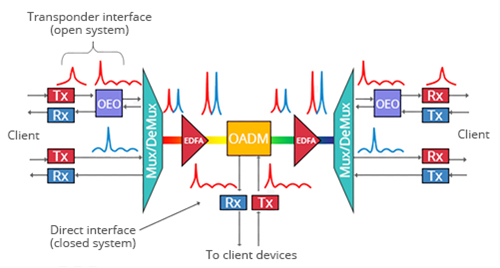
On the client side, the DWDM node converts the local connection to a channelized frequency or wavelength, which is then multiplexed with other lambdas and transmitted over a single fiber connection. The Transponder interface in a DWDM node performs the conversion from the client side grey wavelength to a channelized lambda or colored wave.
The colored wave is then transported to an optical Mux/Demux port matching the tuned wavelength. Mux/Demux multiplexes multiple colored wavelengths together onto an aggregated signal over a single fiber. The aggregated signals are next passed into a Reconfigurable Optical Add-Drop Multiplexer (ROADM), which is configured to add specific lambdas from the node to the dark fiber line.
The aggregated signal from the ROADM is then passed on to an amplifier to boost the signal on the outbound connection. The node may also employ a pre-amplifier that boosts an incoming aggregated signal as it comes into the node from another location, prior to passing on to a ROADM to drop or pass signals at that node. This is the ring of DWDM system.
Several 10G DWDM Network Solutions
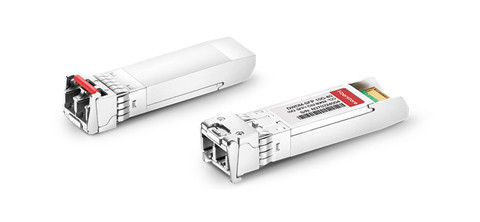
Different specifications of DWDM have different supporting transmission distances. For example, the theoretical transmission distance of 1G DWDM SFP optical modules can reach 100km, while 10G DWDM SFP+ optical module support theoretically up to 80km, so it is essential to choose a kind of optical module that meets the practical needs. However, in the some cases, we may need to extend the transmission distance of the network without replacing optical module, so that some other devices will be required to ensure the transmission quality of the optical signal. Here we will take the DWDM network of 10G DWDM SFP+ optical module as an example to explain the fact that how to extend transmission distance by increasing devices.
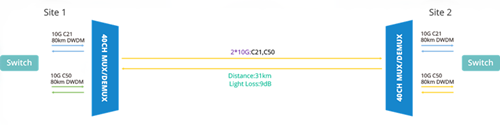
- Instance 1: 31km DWDM network
There are two strands of optical signal transmitted between site 1 and site 2, which are operated over C21 and C50 10G DWDM SFP+ transceiver modules separately. The 80km DWDM SFP+ module can support an actual distance of 31 km without increasing other devices, and the data transmission rate can reach to 10Gbps. The light loss of whole solution is 9dB. 40CH DWDM mux/demux is needed for future proofing.
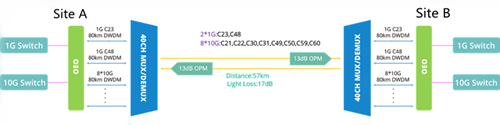
- Instance 2: 57km DWDM network
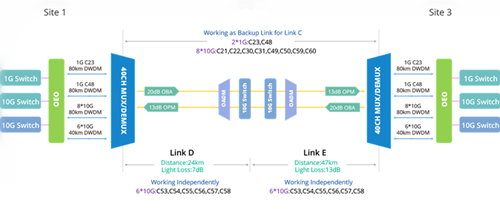
For longer distance of the DWDM network, OEO is required to transfer all the regular signals into DWDM signals to decrease the risks of fault caused by high power consumption. According to the figure 3, there are two 1G signals and eight 10G signals that are operated on different wavelengths with 80km DWDM modules between site A and site B. The actual linking distance of this layout is 57km with the light loss of 17dB.
- Instance 3: 24km + 47km DWDM network
This solution is the backup plan for instance 2. To overcome the light loss, apart from deploying OEO and DWDM MUX/DEMUX, OADM is also necessary to support the same 6 wavelengths added in Site 4 to ensure Link D and Link E to work independently.
Conclusion
The three instances above are the actual calculated transmission distance of 10G DWDM networks. The solution seems to be quite easy, but you need to pay attention to the optical loss and the budget of dispersion compensation. Besides the DWDM optics, FS.COM offers a full range of WDM devices including EDFA. OEO, DCM, OLP, VOA, etc. For the detailed information about the above layout, please contact us directly.
Introduction to CFP-40G-LR4 and CFP-100G-LR4
The C form-factor pluggable (CFP) is specified by a multi-source agreement (MSA) among many manufacturers for the transmission of high-speed digital signals. The CFP transceiver can both support 100 Gbit/s or OTU4, and 40Gbit/s OTU3 signals. The 40G and 100G CFP transceivers are hot-swappable input/output devices that can be plugged into the 40-Gigabit and 100-Gigabit Ethernet module ports. CFP-40G-LR4 has the same footprint as CFP-100G-LR4, and both of them terminate with duplex SC fiber connectors. Except that they support different transmission distance, what are the detailed information about them?

40G CFP-40G-LR4
The Cisco CFP form factor can also operate over 40GbE, supporting both single-mode and multimode fiber and a variety of data rates, protocols, and link lengths, including all the physical media-dependent (PMD) interfaces contained in the IEEE 802.3ba Task Force. 40GBASE CFP optical transceiver module supports 40GBASE Ethernet and OTU3 standards, which can be used in core and distribution layers of data center enterprises, and service provider networks. Cisco releases CFP-40G-LR4, CFP-40G-SR4, and CFP-40G-FR modules.


CFP-40G-LR4, similar with QSFP-40G-LR4, is compatible with IEEE 40GBASE-LR4 standard and operates link length of up to 10km over standard single-mode fiber(OS2). However, CFP-40G-LR4 uses SC duplex connectors with a larger form factor, while QSFP-40G-LR4 utilizes LC duplex connector with a compact footprint ( as shown in the above image).
CFP-100G-LR4
100G CFP modules use 10 x 10 Gbit/s lanes in each direction (RX, TX), the optical connection can support both 10 x 10 Gbit/s and 4 x 25 Gbit/s variants of 100 Gbit/s interconnects (typically referred to 100GBASE-SR10 in 100 m reach respectively and 100GBASE-LR4 in 10 km reach.)
Cisco 100GBASE-LR4 CFP is the 100G CFP type that was designed for long-reach 100GbE applications. CFP-100G-LR4 supports a link length of 10 km on standard SMF with duplex SC connectors. It is running at four optical wavelengths (1295.56 nm, 1300.05 nm, 1304.59 nm, 1309.14 nm) and muxing/demuxing of these wavelengths happening inside CFP module.
Comparison Between CFP-40G-LR4 and CFP-100G-LR4
CFP-40G-LR4 and CFP-100G-LR4 share many points in common, such as the wavelength, fiber type, max distance, fiber optic connector and DOM support. Nevertheless, CFP-40G-LR4 is used in 40GbE network, and CFP-100G-LR4 is in 100GbE.

To further understand the difference between CFP-40G-LR4 and CFP-100G-LR4, let’s have a look at the CFP architecture. According to the below image, the whole CFP diagram is composed of two parts—equipment Line card ASC or FPGA, line card interface and optical line interface. There are several “M-Lines” with 10Gbps speed between equipment line card and electrical interface.

If CFP is working 100GBase-LR4 mode, then it has 10 x 10Gbps M-Lines. As to 40GBase-LR4, it uses 4 x 10Gbps M-Lines. The “gear box” in the image is electrical 10:4 mux/demux module aggregating up to 10 M-Line interfaces in maximum 4 N-Line interfaces. Each N-Line is 25Gbps for 100GBase-LR4 and 10Gbps for 40GBase-LR4. So you may clearly understand the difference between CFP-40G-LR4 and CFP-100G-LR4.
Conclusion
The CFP MSA transceiver module defines hot-pluggable optical transceiver form factors to enable 40GbE and 100GbE applications. CFP-40G-LR4 and CFP-100G-LR4 are the CFP LR4 optics that are compatible with 40GBASE-LR4 and 100GBASE-LR4 standards. Other than the CFP form factor modules, pluggable CFP, CFP2 and CFP4 transceivers support the ultra-high bandwidth requirements of data communications and telecommunication networks that form the backbone of the internet. FS.COM offers a whole sale of CFP/CFP2/CFP4 optical transceivers that available in several standards. Please feel free to contact us if you need anything.
CPAK Vs. CFP/CFP2/CFP4 Vs. QSFP28 100G Transceiver Modules
100G QSFP28 and CFP optical transceivers as the main transmission media of 100G network, dominate 100G hardware market. CPAK, launched right after CFP2 100G modules, is the Cisco proprietary form factor. Since its certification, CPAk was considered as the alternative of CFP form factor modules. Today's article will describe CPAK 100G module in detail and compare it with other 100G modules such as CFP, CFP2, CFP4 and QSFP28 modules.
What is CPAK Optical Transceiver Module?
Designed as a smaller, low-cost alternative to CFP transceiver, CPAK 100GBASE optical module is not popular on the 100G market nowadays. CPAK module is also the first 100G optical transceiver that uses CMOS Photonics technology. This type of 100GBASE module can work in the following Cisco networking equipment—ASR 9000 Series Router; CRS-X Carrier Routing System; NCS 2000, 4000, and 6000 Series Routers; the Nexus 7000 and 7700 Series Switches, and the Cisco ONS Transport Platform.

CPAK optical transceiver incorporates IEEE standard interfaces available in several different standards: 100GBASE-SR10, 100GBASE-ER4L, 100GBASE-LR4, 10x10G-ERL, 10x10GBASE-LR, etc. CPAK transceivers can support 10X10Gbps and 4X25Gbps mode for an aggregate of 100Gbps data rate (seen in the above image). It can operate high-density 10G breakout with MPO-24 cables, CPAK-100G-SR10 is operating in this type, which is also backward compatible with 10GBASE-SR. CPAK LR4 module is compatible with other 100GBASE-LR4 compliant modules such as CFP to support high-bandwidth 100Gb optical links over standard single-mode fiber terminated with SC connectors.
The main features of CPAK modules are backward compatibility, smaller form factor and energy efficiency.
CPAK Vs. CFP/CFP2/CFP4
As noted before, CPAK was released right after CFP modules. Although CFP is the pioneer in 100G optics, but its big size can not meet the demands of high-density data center. Therefore, CFP2 and CFP4 with more compact sizes are developed. When comparing CPAK with CFP modules, CPAK transceivers are less than one third the size of CFP modules, and dissipate less than one third the power. In a comparison with CFP2 modules, CPAK optical transceivers are 20% smaller and consume 40% less power. In other word, if you use CPAK other than CFP2 modules in your data center switches, it can offer 20% greater port density and front-panel bandwidth.

In short, CPAK optical module has smaller footprint than CXP, CFP and CFP2, but bigger than CFP4 and QSFP28 optics. Besides, CPAK 100GBASE-LR4 consumes less than 5.5W, which is less than CFP LR4 (24W), CFP2 LR4 (12W), CFP4 (9W) and CXP LR4 optics (6W) but a little higher than QSFP28 (3.5W). CPAK represents a significant advancement in optical networking, providing dramatic space and power efficiency.
CPAK Vs. QSFP28
QSFP28 optical transceiver, due to its smallest form factor and lowest power consumption, is regarded as the most promising 100G optical module. In terms of the form factor, QSFP28 is more compact then CPAk modules. As to the power consumption, Cisco CPAK 100GBASE-LR4 module supports link lengths of up to 10 km over standard single-mode fiber with SC connector with a nominal power consumption of less than 5.5W. QSFP28 100GBASE-LR4 supports up to 10km and consumes nearly 3.5W.
QSFP28 transceiver is designed for 100G speeds and using the 4×25 wiring specification. 100G QSFP28 SR4 is designed for short-haul transmission and QSFP28 LR4 is designed for long-haul transmission.

Summary
In 2017, 100G technology and relevant optical transceivers gradually become matured. 100G optics like CXP, CFP/CFP2/CFP4, 100G QSFP28 in different standards offers a huge selection for customers. CPAK module was launched just days after the certification of CFP2 optics. It is popular for the smaller footprint and energy economy. However, when competing with open source MSA compatible 100G products (CFP/CFP2/CFP4 and QSFP28), CPAK is not the ideal one for 100G high-density connectivity. However, many third party optical solution vendors like FS.COM announce to help market to cut down this pricing and save budgets for customers. FS.COM will release this cable in the near future, if you are interested, please contact us.
How to Choose SFP Transceiver Modules for UniFi US-8-150W Switch?
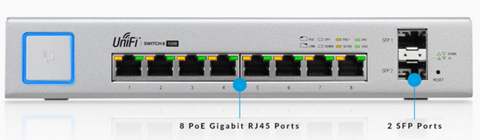
Ubiquiti Networks Unifi switch is part of the UniFi line of products that delivers robust performance and intelligent switching for the growing networks. Many customers nowadays hold great feedback about the cost-effective UniFi switches. US-8-150W, as one of the most popular UniFi switches, offers eight Gigabit RJ45 ports and 2 SFP ports that can support up to 1Gbps. So, how to choose the suitable optics for UniFi US-8-150W switch? This article will provide detailed information about this UniFi switch and the appropriate SFP modules for US-8-150W switch (seen in the below image).
Understanding UniFi US-8-150W Switches
Ubiquiti Networks UniFi switches can be divided into two types: managed Gigabit switches and managed PoE+ Gigabit Switches. In short, POE switches and non-POE switches. Each UniFi switch type is fully managed Gigabit switches with RJ45 and SFP+/SFP ports, offering non-blocking throughout switching performance.
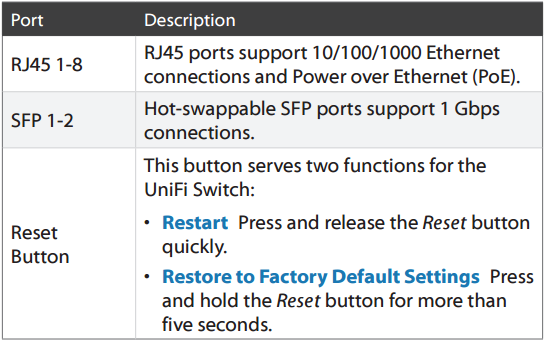
US-8-150W UniFi switch features 8 RJ45 ports and 2 SFP ports which offer convenient different power output options, auto-sensing IEEE 802.3af/at POE/POE + performance. It is a bit larger than a standard home switch. So, would-be buyers who are looking to rack mount need to buy a extra shelf and stick it there. The table below provides the clearer information about this switch.
Note that US-8-150W is only US $199.
How to Select SFP Modules for UniFi US-8-150W Switches?
According to Ubiquiti Networks, both their original and third party SFP transceiver modules from other vendors can be used on UniFi switches.
Ubiquiti Networks UF-MM-1G & UF-SM-1G-S
Ubiquiti Networks only offer two type of SFPs—UF-MM-1G and UF-SM-1G-S. UF-MM-1G SFP module supports a data rate of 1.25 Gbps over multimode fibers. It uses the 850nm as the Tx and Rx wavelength with a supporting distance of 550m.
UF-SM-1G-S is a single-mode SFP available in both blue (1310nm) and yellow (1550nm) color code. Unlike the 1000BASE-LX SFP optics with LC single-mode fibers that can operate up to 5 km, UF-SM-1G-S only supports a link limit of 3 km.
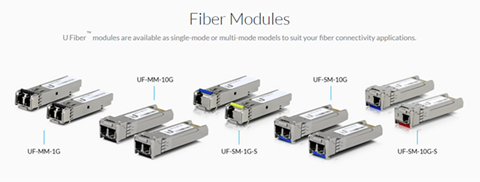
Figure 3 presents all the existing fiber optic transceivers (SFP and SFP+) from Ubiquiti Networks. UF-SM-1G-S is in the middle of the image.
3rd Party SFPs for US-8-150W Switch
Besides the above two SFP types, there are several more Gigabit Ethernet standards for SFP transceiver modules—1000BASE-T, 1000BASE-SX, 1000Base-LX/LH, 1000BASE-ZX, 1000BASE-BX-D, 1000BASE-BX-U and 1000BASE-EX, which are compatible with the UniFi switches. According to the Ubiquiti Networks, Fiberstore (FS.COM) SFPs are tested to be fully compliant with UniFi switches. For more information about these compatible SFPs, please check on the following list.
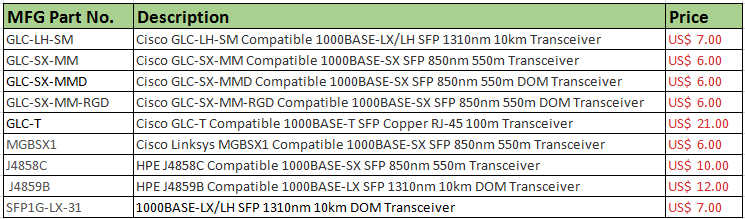
From the table, we know that several Cisco SFP modules and HPE SFP transceivers are working on the UniFi Switches. In our test center, we have tested the GLC-T compatibility and Cisco GLC-SX-MM compatible issues.
More Information About UniFi Switches
Besides the hot selling US-8-150W switches, there are a series of UniFi switches such as US-8-60W, US-16-XG, US-48, US-8, US-24, US-48-750W, US-48-500W, US-24-250W, US-24-500W. Whether you use which one, FS.COM SFPs in the above table are tested to be fully compatible with UniFi switches. For such a low price of the 3rd party SFP transceiver modules, it is advisable for you to purchase more optics for backup.
Summary
The UniFi US-8-150W switches are designed to be part of the complete line of small business or home networking and wireless communication products that work together as part of proven, fully integrated, easy-to-use small business solution. UniFi switches support several types of Gigabit Ethernet SFP optical transceivers. All these high-quality fiber optic transceivers can be found on FS.COM for great prices. We also make sure to provide its customers same day shipping. Some of the items can be directly shipped from Seattle warehouse.
Comparing Three Fiber Optical Transceiver Manufacturers – Monoprice, Fluxlight & Fiberstore
If you search reliable fiber optic transceiver module manufacturers on Google, you will get thousands of results in a few seconds. But, where should you get the high-quality and low-price fiber optic transceiver modules? Monoprice, Fluxlight and Fiberstore as the representative of reputable optical transceiver manufacturers, are frequently recommended by many users. Are their fiber optic transceiver module worth any penny you spend? This article will decode these three companies and provide a vivid comparison between their fiber optic transceivers.
Monoprice—A Reliable Cable Supplier
Founded in 2002, monoprice used to be famous as a leading cable manufacturer, but now it develops to allow customers pulling together the whole computer system. Monoprice has built a stellar reputation for product excellence and customer services. The following are the screenshots of monoprice’s feedback. “The great part of monoprice is that we allow our customers to do things they want to do with price far below what competitors charge” says by the CEO of monoprice.


According to monoprice, they offer over 6,500 high-quality, affordable electronics and accessories to professionals and consumers worldwide. Cables such as the HDMI cables, networking patch cables, bulk networking cables are offered in variable standards and different cable length. As for the fiber transceivers, they recently do not offer many types of fiber optic transceivers. Their existing compatible fiber transceivers are from Ironlink. For example, the Ironlink Cisco SFP-10G-SR from monoprice is the Cisco Compatible 10GBase-SR SFP+.
Fluxlight
Fluxlight, established in 2003, manufactures and sells optical products for use in communication fields. Products like optical transceivers, media converters, jumper cables, and patch cables are welcomed by users. FluxLight only offers brand-new, top-quality optical interconnect products that are guaranteed to be compatible with vendors like Cisco, 3com, Dell, D-Link, Extreme, Juniper, HP, and Finisar.
Fiberstore—A Cost-effective Optical Transceiver Manufacturer
Founded in 2009, Fiberstore (FS.COM) gradually becomes a leading company devoting to research & development, and offer fiber connectivity network solutions for carriers, ISPs, content providers and networks. With a few years of development and accumulation, Fiberstore have owned a whole series of optical communication products including the WDM equipment, transceivers, fiber optic assemblies, racks & enclosures, bulk fiber cables, enterprise network and so on.
Their wholesale fiber optic transceiver products are offered at the lowest price and fully compatible with the original devices. They assured to every customers that every fiber transceiver offered by Fiberstore before shipping has to go through strict test to assure 100% compatibility and high performance.
Fiber Optic Transceivers From Monoprice, Fluxlight and Fiberstore
Monoprice, Fluxlight and Fiberstore are offering several types of fiber optic transceivers. Where should I get the fiber transceivers? The following part will draw a brief comparison between them from the aspects of price, selection, and reputation.
- Fiber Transceiver Price—Monoprice Loses
Price is the number one factor that people would take into account. We can’t list all the products from their website and compare them here. So let’s take the 10G SFP+ modules as an example, the Ironlink Cisco SFP-10G-SR from monoprice is sold at $136.75. Fluxlight SFP-10G-SR is only $54.00. The price of Cisco compatible SFP-10G-SR from FS.COM is $16.00.

In the above image, Ironlink Cisco SFP-10G-LR from monoprice is $315.00. SFP-10G-LR from Fluxlight is $134.00. However, Fiberstore Cisco SFP-10G-LR is $34.00. Note that the above price do not include the delivery fees. You need to consult with salesmen about your final payment.
- Products Options
Both Fiberstore and Fluxlight offers a full range of fiber optic transceivers that are fully compatible with many brands. While monoprice, nowadays do not have many selections of optical modules. But if you need HDMI, Video or power cables, you can definitely have a look at their website.
- Reputation—Fiberstore Wins
Fiberstore is known as the cost-effective optical transceiver manufacturer that offers high-quality and low price compatible products. Monoprice is mostly recommended for its patch cables. If you don’t buy it, you can have a look at the following screenshots.


Conclusion
Can I order any branded fiber optic transceivers? Or should I buy the cheap OEM optical modules? Customers often ask about the similar questions when selecting reliable optical transceivers. This article compares the fiber optics from Monoprice, Fluxlight and Fiberstore. I bet readers must know how to make their choices.
Multimode Fiber Cabling Upgrade From 10GBASE-SR, 40GBASE-SR4 to 100GBASE-SR10
Telecom industry is in the best times in that new products and technologies keeping coming out, which greatly facilitate people’s daily lives. From the 10GbE, 40GbE to the 100GbE, users can be benefited from the varieties of Gigabit Ethernet applications. Pluggable from factor (SFP+, QSFP+, CFP) used in different Gigabit Ethernet that can support the multimode fibers (MM) leads to lower costs and low power consumption. By comparison of single-mode modules, MM optical transceivers enables a single build standard for short-reach connection in data centers. Today’s article will briefly illustrate the multimode cabling upgrade in 10G, 40G and 100G Ethernet.
10GBASE-SR, 40GBASE-SR4, 100GBASE-SR10 Wiki
According to wikipedia, there are similarities and differences between three standards. Let’s have a quick overview of it.
10GBASE-SR (short range) is a port type for multi-mode fiber (OM3 and OM4) and uses 850 nm lasers. Its Physical Coding Sublayer 64b/66b PCS is defined in IEEE 802.3 Clause 49 and its Physical Medium Dependent PMD in Clause 52. It delivers serialized data at a line rate of 10.3125 Gbit/s. The 10GBASE-SR transmitter is implemented with a VCSEL which is low cost and low power. 10GBASE-SR delivers the lowest cost, lowest power and smallest form factor optical modules with a link length of 300m over OM3, and 400M over OM4.
- 40GBASE-SR4
40GBASE-SR4 is a port type for multimode fiber and uses 850 nm lasers. Its Physical Coding Sublayer 64b/66b PCS is defined in IEEE 802.3 Clause 82 and its Physical Medium Dependent PMD in Clause 86. It uses four lanes of multimode fiber delivering serialized data at a rate of 10.3125 Gbit/s per lane. 40GBASE-SR4 has a reach of 100 m on OM3 and 150m on OM4.
- 100GBASE-SR10
The IEEE P802.3ba Task Force developed a single architecture capable of supporting both 40bE and 100GbE. 100GBASE-SR10, which is defined as 10 wavelengths across 10 parallel fiber paths at 10Gbps on multimode fiber (operating at 850 nm). Its Physical Coding Sublayer 64b/66b PCS is defined in IEEE 86 (802.3ba). It uses ten lanes of multimode fiber delivering serialized data at a rate of 10.3125 Gbit/s per lane. 40GBASE-SR4 has a reach of 100 m on OM3 and 150m on OM4.
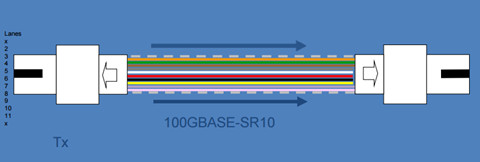
40 GbE links are re-used in this diagram, and require additional MTP/MTP trunk to complete channel, fibers 1 and 12 go dark.
10GBASE-SR, 40GBASE-SR4, 100GBASE-SR10 in Different From Factors
- 10GBASE-SR SFP+
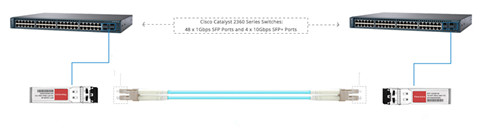
10GBASE-SR optical transceivers uses 10G SFP+ form factor with duplex LC connector. The range of this module depends on the type of multimode used. It generally supports a link length of 26 meters on standard Fiber Distributed Data Interface (FDDI)-grade multimode fiber and can also support link length up to 400 meters over OM4 multimode fiber. The following image shows the simplest solution between two Cisco switches by using the 10GBASE-SR SFP module optics.
- 40GBASE-SR4 QSFP+
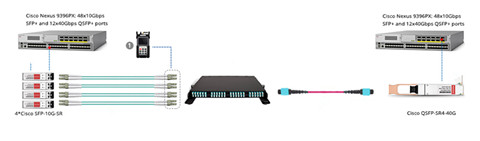
40GBASE-SR4 optical transceiver is QSFP+ form factor, primarily enabling high-bandwidth 40GbE optical links over 12-fiber parallel fiber terminated with MPO/MTP multifiber female connectors. In general, it can support link lengths of 100 and 150 meters, respectively on OM3 and OM4 multimode fibers. In addition, using 12-fiber MPO/MTP to 6 duplex LC or 8-fiber MPO/MTP to 4 duplex LC breakout cable, the 40GBASE-SR4 interface can be divided into four 10GBASE-SR interfaces.
- 100GBASE-SR10 CFP
CFP is the typical representative form factor of 100GBASE-SR10. The 10GBASE-SR10 CFP uses 24-fiber MPO/MTP optical interface, enabling high-bandwidth 100GbE links over 24-fiber ribbon cables terminated with MPO/MTP-24 connectors. Alternatively, 2 x 12-fiber MPO connector interface can be used where one connector is used for Receive while the other for Transmit. The 100GBASE-SR10 CFP can supports link lengths of 100 meters and 150 meters respectively on laser-optimized OM3 and OM4 multifiber cables. Additionally, it can be used in 10 x 10GbE mode along with ribbon to duplex fiber breakout cables for connectivity to ten 10GBASE-SR optical interfaces.
Conclusion
This article concludes the features of multimode cabling upgrade from 10G to 100G. multimode modules together with its lower price tag and low power consumption, are compelling to overall users. FS.COM, as a reliable china optical transceiver module manufacturer offers a full range of hot-selling fiber optics like SFP, SFP+, QSFP+, QSFP28 and CFP modules. They comes in different standards and full compatible with major brand. If you are interested, please visit our site.
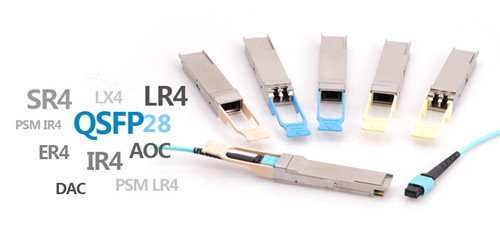
QSFP28 100G Transceivers & DAC Guide
Telecom industry embraces the prosperity of 100G optics market in 2017. With such a bright future, fiber optic market attracts a wide attention, and many vendors want a piece of the pie. The 100G optics like the CFP, QSFP28 modules and cables are varied in different standards. QSFP28 optics, along with its compact size and reliable performances, gradually becomes the mainstream form factors of the 100G optics market. QSFP28 modules come in different standards (LR4, SR4, PSM4, CWDM4), and the QSFP28 AOC and DAC cables are also available for 100G systems. Which one is ideal for your 100G network? This article attached with the detailed information of all the 100G optics, will blew your mind.
QSFP28 DAC Inside Rack: <5 m
QSFP28 passive DAC cables are launched to decrease the cost of 100G systems, which provide a cost-effective I/O solution for 100GbE connectivity within 5 m. QSFP28 to QSFP28 DACs and QSFP28 to 4x SFP28 DACs are the two common types of the QSFP28 DAC cables. QSFP28 to QSFP28 direct attach cable is usually used inside racks with QSFP28 connectors terminated on each end. QSFP28 breakout DACs can achieve 25G to 100G transmission with a QSFP28 connector on one end and 4 SFP28 connectors on the other end. If your 100GbE deployment is within 5m intra racks, the QSFP28 DAC is ideal for you.
QSFP28 AOC: Up to 100 m
The QSFP28 AOC is a cost-efficient, four-channel optical transceiver that conforms to the QSFP28 multi-source agreement. It is capable of delivering 100-Gbps data rates over four lanes of 25 Gbps with a reach of up to 100 m, maximum. Just as the QSFP28 DAC, QSFP28 AOC cable also comes in two types—QSFP28 to QSFP28 AOC and QSFP28 to 4SFP28 AOC. The former one is best fit for 3-20 m, and QSFP28 breakout can support a link length of up to 100 m. The QSFP28 AOC supports InfiniBand EDR and 100 Gigabit Ethernet (100GBase-SR4) transmission speeds and is best for close-range, high-speed transmission in data center networks, such as between servers and server racks.
QSFP28 SR4 Close Range: 5-100 m
For 100GbE cabling with multimode fiber between switches, QSFP28 SR4 with 12-fiber OM4 MTP fiber cable is the perfect choice. It can support reaches up to 100 m over OM4. The 100Gbase-SR4 QSFP28 module achieves four lanes of 25G dual way transmission over eight fibers. QSFP28 SR4 module is compliant with 100GBASE-SR4 standard certificated by IEEE. It is the firstly published 100G standard to support short distance over multimode fibers. Many vendors offer the compatible QSFP28 SR4 optics with good quality and high reliability. FS.COM is one of the best that can provide the test-assured OEM optics with great customer feedback. All the products included in the below chart are provided at FS.COM.

QSFP PSM4 Between Switches: 100 m-500 m
For 100G connectivity, if the reaches are beyond 100m but less than 500m, you can use the QSFP PSM4. Unlike the QSFP28 SR4 optics (by IEEE), PSM4 standard is published by MSA. 100G PSM4 QSFP28 is designed to support a transmission distance up to 500 m over MPOI single-mode multi-fibers.
QSFP CWDM4 Mid-Reach: 500 m-2 km
Reaches less than 2 km are usually called mid-reaches. QSFP28 CWDM4 is the module designed to meet the mid-reach requirements. MSA published 100Gbase-CWDM4 standard for QSFP28 over single-mode up to 2 km over through duplex LC interface. It uses WDM technologies like 100Gbase-LR4. But the transmission distance is shorter and the cost is much lower.
QSFP28 LR4 Long Span: ≤10 km
For long distance transmission between two buildings, the IEEE standard 100Gbase-LR4 is being used in QSFP28 form factor which is known as QSFP-100G-LR4 module. Unlike QSFP-100G-SR4 modules, QSFP-100G-LR4 uses the WDM technologies for four 25G lanes transmission. The four 25G optical signals are being transmitted over four different wavelengths. It has a duplex LC interface for 100G dual-way transmission. 100Gbase-LR4 QSFP28 can support transmission up to 10 km over single-mode fiber. But one problem is that the cost of QSFP28 LR4 is very high now. What’s worse, you would need the EDFA to offset the link loss.
Conclusion
To achieve higher data-rate transmission speed, new network design will work to bring us closer to meet the needs of a Big Data future. This article concludes the features of existing QSFP28 100G products on the market. After going through the whole passage, you must know which one is ideal for your network.
